Stay Informed
FPC announcements, stories from the porch, and curated news about neuroinclusive housing and disability advocacy from around the country.
From Front Porch Cohousing
Our Announcements
The Loneliness Nobody Talks About: Why Housing Is the Wrong Answer to the Right Question
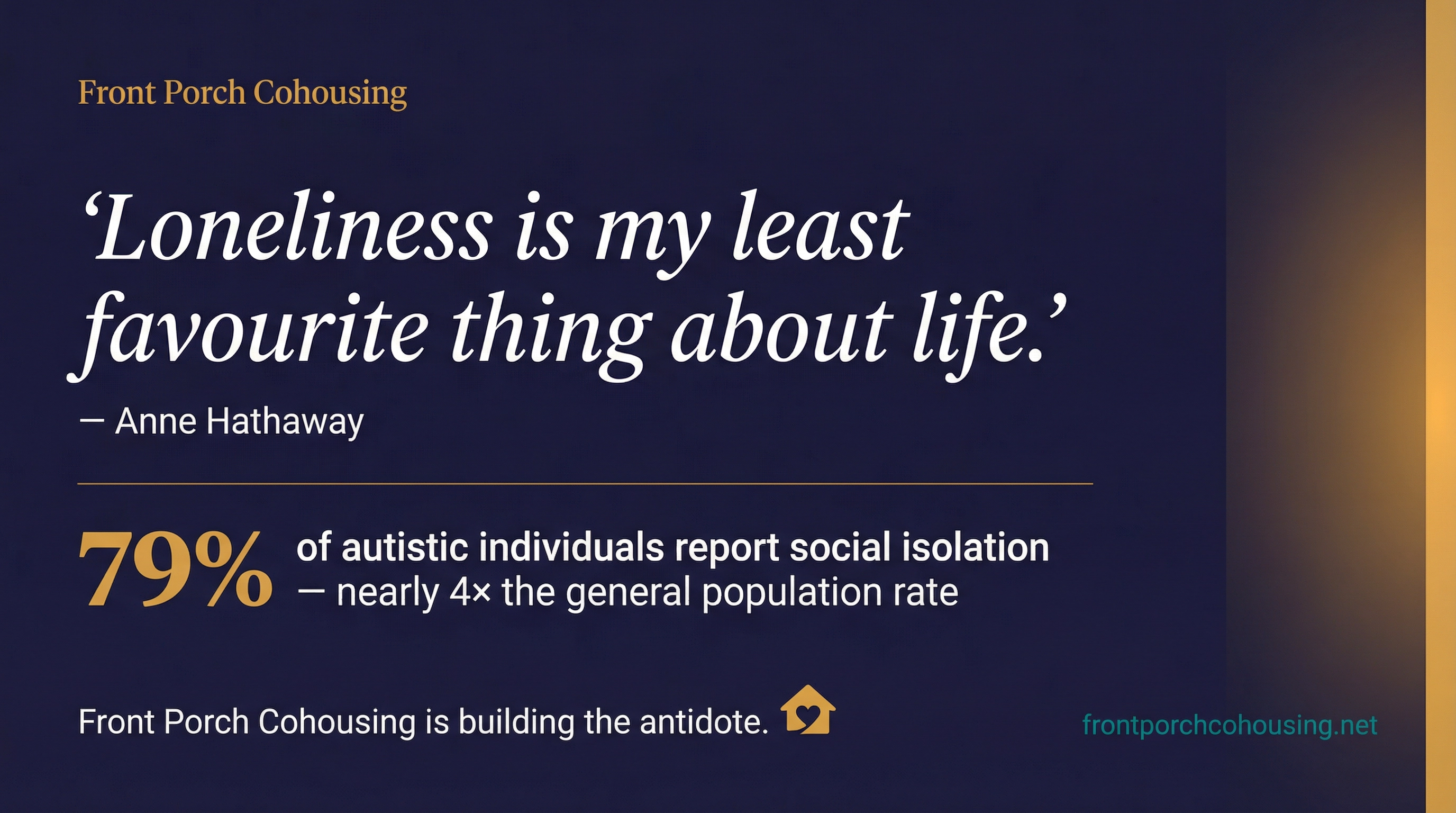
Anne Hathaway recently said loneliness is her least favourite thing about life. Now consider that 79% of autistic individuals report chronic social isolation — nearly four times the general population rate. The housing shortage is real. But the loneliness crisis hiding inside it may be even more urgent.
There is a quote making the rounds this week from Anne Hathaway — one of the most recognized actresses in the world, a person with every material advantage modern life can offer — that stopped us cold.
“Loneliness is my least favourite thing about life. The thing that I’m most worried about is just being alone without anybody to care for or someone who will care for me.”
— Anne Hathaway
Read that again. A woman with wealth, fame, and a full life is kept awake by the fear of being alone. Now consider the 7.3 million adults in the United States living with intellectual and developmental disabilities — people who, statistically, face that fear not as a distant worry but as a daily reality.
79%
of autistic individuals report experiencing social isolation — nearly four times the rate of the general population. And for adults with IDDs more broadly, research from the University of Minnesota finds that half report chronic loneliness, compared to 15–30% of the general population.
The Housing Shortage Is Real. But It’s Not the Whole Story.
The statistics about housing access for adults with IDDs are staggering. There are 7.3 million adults with IDDs in the United States. Only 2 percent live in settings that offer genuine community integration. In Pennsylvania alone, more than 13,000 people are on the waiting list for Medicaid waiver services — with an average wait of 10 to 15 years.
But there is a second crisis hiding inside the first one — quieter, less visible, and in some ways more damaging. Most adults with IDDs who do have housing live in congregate group homes that prioritize compliance over community, or isolated rental units that provide shelter but not belonging. Neither model was designed with the understanding that human beings — all human beings, regardless of neurotype — require genuine social connection to thrive.
The science on this is unambiguous. Chronic loneliness increases the risk of heart disease by 29 percent, stroke by 32 percent, and dementia by 50 percent. It is, as researchers now describe it, a medical emergency. And for adults with IDDs, who already face elevated health risks across the board, the compounding effect is severe.
What Parents Carry
Every parent of an adult child with an IDD knows a specific kind of fear. It surfaces at odd moments — at the kitchen table, in the car, at 2 in the morning. It is not the fear of today. It is the fear of after.
Who will be there when I’m not? Will she have friends — real ones, not paid staff, not scheduled activities, but people who choose to be with her? Will he have a home that is truly his — a place he belongs, a place he owns, a place that cannot be taken from him when funding changes or an agency closes?
These are not small questions. They are the questions that define the second half of parenthood for millions of American families. And for too long, the system has answered them with waiting lists, group placements, and the quiet assumption that independence and community are luxuries adults with IDDs cannot expect. We reject that assumption entirely.
The Antidote Is Not Just Housing. It’s Belonging.
Front Porch Cohousing was built on a different premise: that the answer to loneliness is not proximity, but community. That the answer to housing insecurity is not rental assistance, but ownership. And that the answer to isolation is not programming, but design.
Our model brings adults with IDDs into intentional cohousing communities where they own their homes — whether through a purchased condo, a single-family residence, or fractional co-op ownership. They build real equity. They have a legal stake in their community. And they live alongside neurotypical neighbors in a mixed, intentional setting designed from the ground up to foster genuine connection.
This is not a group home. It is not a facility. It is a neighborhood — one where the architecture, the programming, and the culture are all oriented toward the same goal: making sure that no one has to face the fear that keeps Anne Hathaway awake at night.
What You Can Do
Sources: Friendship Circle / Autism research consensus (79% social isolation); Ee et al., Autism Adulthood, 2019 (4× loneliness rate); Stancliffe et al., Intellectual and Developmental Disabilities, 2007 (50% chronic loneliness); Holt-Lunstad et al., Perspectives on Psychological Science, 2015 (health consequences); Anne Hathaway, Interview Magazine.
Capital Campaign Launch: Building Our First Neuroinclusive Community
Front Porch Cohousing is thrilled to announce the official launch of our capital campaign to fund our first neuroinclusive cohousing community in Bucks County, Pennsylvania. This milestone marks years of planning, advocacy, and community building.
Winter 2026 Golden Ticket Raffle — Support Our Mission
Join our annual raffle to support neuroinclusive housing. Every ticket helps us build communities where adults with IDDs can truly thrive. This year's prizes include vacation packages, local experiences, and more.
Front Porch Cohousing Receives 501(c)3 Status
We are proud to announce that Front Porch Cohousing by NDL has received official 501(c)3 nonprofit status from the IRS. This milestone enables us to accept tax-deductible donations and pursue grant funding for our capital campaign.
Curated from Disability Scoop
In the News
Articles sourced from Disability Scoop, the premier source of disability news. Updated regularly.
Stay Connected
Sign up for our newsletter to receive FPC announcements, event invitations, and curated disability housing news directly in your inbox.